Quick Answer Box: THCA legality by state varies sharply across Ohio, Indiana, and Missouri heading into November 2026. Missouri stays the most open Midwestern market, accepting bulk Farm Bill-compliant THCA flower and concentrates. Indiana bars smokable hemp but permits non-smokable THCA products. Ohio’s Senate Bill 56, effective March 20, 2026, shut down unregulated THCA retail, making bulk flower shipments there legally unworkable.
What Is THCA Legality by State, and Why Does It Matter for Midwest Wholesale Buyers?
THCA legality by state describes the rules governing whether hemp-derived tetrahydrocannabinolic acid can be legally sold, shipped, or stocked in a given jurisdiction. As of mid-2026, each state layers its own requirements on top of the federal 0.3% delta-9 THC standard. Ohio, Indiana, and Missouri each represent a distinct tier of that layering, from effectively closed to still open for business.
The federal framework underpinning all three states is the 2018 Farm Bill, which defined hemp as cannabis containing less than 0.3% delta-9 THC by dry weight. That definition is changing. H.R. 5371, enacted November 12, 2025 as P.L. 119-37, Section 781, shifts federal hemp compliance to a total-THC formula: (THCA x 0.877) + delta-9 THC must not exceed 0.3% dry weight. The new standard takes effect on November 12, 2026. After that date, most current THCA flower fails the federal definition regardless of any state rules. For retailers and THCA suppliers planning their buying cycles, understanding where each state currently stands is the starting point. The USDA Domestic Hemp Production Program sets the federal floor every state builds from.
Is THCA Still Legal to Ship to Ohio After Senate Bill 56?
Bulk THCA flower shipments to Ohio are now effectively prohibited, and this THCA legality by state update is one of the most consequential of the year. Senate Bill 56, signed December 19, 2025, and effective March 20, 2026, rewrote Ohio’s hemp framework in a single stroke. Any hemp-derived product exceeding 0.4 milligrams of total THC per container is now classified as marijuana under Ohio law and must move through a licensed dispensary. The Ohio Division of Cannabis Control confirmed that intoxicating hemp products formerly on retail shelves are “no longer permitted to be sold anywhere” outside the licensed cannabis system.
THCA flower makes the 0.4mg cap impossible to meet at any commercially relevant concentration. A single gram of flower at 20% THCA contains roughly 200mg of the compound, thousands of times above the container limit. High-THCA concentrates face the same ceiling. The licensed cannabis pathway that remains requires Ohio-licensed cultivators and processors, which means out-of-state hemp suppliers cannot fill orders through the hemp channel.
Ohio also formally withdrew its state hemp cultivation plan as of December 31, 2025, transitioning licensing directly to the USDA HeMP system. A narrow exception exists: non-intoxicating hemp extracts formulated well below the 0.4mg container limit may still qualify as shippable hemp products, though at bulk wholesale volumes those formulations rarely make commercial sense. Ohio THCA laws 2026 make this state a near-closed market for traditional bulk THCA wholesale.
What THCA Products Can You Still Ship to Indiana and Missouri in 2026?
Indiana and Missouri both remain viable wholesale targets heading into the second half of 2026, though each state draws different lines around product type and documentation requirements.
Indiana THCA Laws 2026: Non-Smokable Products Are Still Legal
Indiana bans all smokable hemp statewide. That prohibition covers THCA flower and pre-rolls outright, regardless of delta-9 THC content. The ban does not reach non-smokable hemp-derived products. THCA concentrates and extracts, tinctures, and edibles that test at or below 0.3% delta-9 THC by dry weight remain fully legal to sell and ship into Indiana. Hemp licensing in the state runs through the Office of Indiana State Chemist under the Indiana State Department of Agriculture hemp program, which aligns with the 2018 Farm Bill’s delta-9 standard.
Indiana THCA laws 2026 avoided a significant tightening. Senate Bill 250, which would have moved the state to a total-THC standard with an effective date of July 2026, died in the Indiana House on February 24, 2026. A competing bill, Senate Bill 478, to create a regulated craft hemp flower market, also failed. Non-smokable THCA products remain a real and active wholesale category in the Hoosier State.
Missouri THCA Laws 2026: The Most Open Midwest Market
Missouri legalized hemp in 2019 under SB 133 without adopting a total THC standard for finished products. Under current Missouri law, a product testing below 0.3% delta-9 THC by dry weight qualifies as legal hemp regardless of its THCA concentration. That framework permits bulk shipments of THCA flower, concentrates, and pre-rolls to Missouri retailers. Recreational cannabis is also legal in Missouri under Amendment 3, but hemp-derived THCA products operate as a separate market category entirely.
Risk in Missouri comes from enforcement posture, not statute. The Missouri Attorney General launched enforcement actions against specific THCA retailers in 2024, and Governor Parson’s Executive Order 24-10 (August 2024) flagged unregulated psychoactive cannabis products for increased scrutiny. No statewide statutory ban resulted from either action. The Missouri Division of Cannabis Regulation confirms it does not regulate hemp-derived products, which remain under the federal program. Retailers operating with full COA documentation are in a defensible position under current Missouri THCA laws.
THCA Carrier Shipping Policies, Shipping Laws, and Lab Requirements
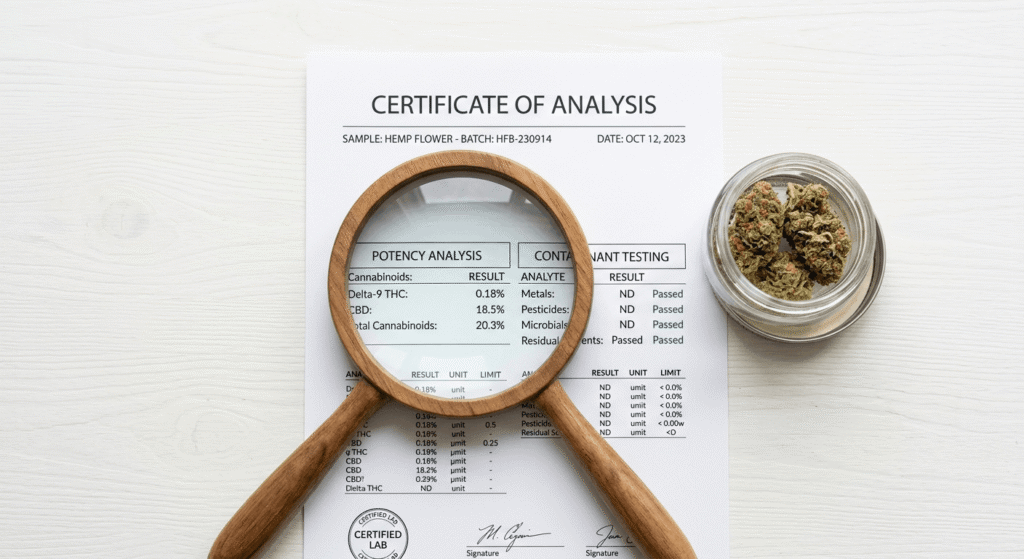
THCA carrier shipping policies apply uniformly across all three states, independent of local legality. USPS accepts Farm Bill-compliant hemp shipments when Certificates of Analysis are on file and retained for at least two years. UPS and FedEx require signed hemp shipper agreements and compliant product documentation. Every bulk shipment into Indiana or Missouri should include a batch-specific COA from an ISO-accredited third-party lab confirming delta-9 THC at or below 0.3%, plus clean pesticide, heavy-metals, and microbial panels. Verify current lab results from your supplier before each order cycle. For Indiana shipments specifically, state shipping laws require product labels to carry a QR code linking directly to the COA.
THCA lab tested shipping is not optional. A shipment without documentation is flagged as unidentified plant material at any compliance check.
| State | THCA Flower | Concentrates and Extracts | Tinctures and Edibles | Risk Level |
|---|---|---|---|---|
| Ohio | Banned under SB 56 (March 2026) | Max 0.4mg total THC per container | Same 0.4mg container limit | High |
| Indiana | Banned (smokable hemp law) | Legal with batch COA | Legal with batch COA | Moderate |
| Missouri | Legal with batch COA | Legal with batch COA | Legal with batch COA | Low to Moderate |
Indiana and Missouri buyers sourcing from compliant THCA suppliers should lock in wholesale pricing before Q4 2026. Once the November 12 deadline passes, the total-THC formula reclassifies THCA-dominant products at the federal level, ending interstate hemp-channel shipping regardless of what Missouri or Indiana law says individually.
Frequently Asked Questions
1. Can you legally ship THCA flower to Ohio in 2026?
No. Ohio’s Senate Bill 56, effective March 20, 2026, caps non-dispensary hemp products at 0.4 milligrams of total THC per container. THCA flower at any commercially relevant potency exceeds that limit by thousands of times. Bulk shipments now require a licensed Ohio cannabis distributor, not a hemp-channel THCA supplier. Shipping flower to Ohio outside that licensed system carries significant legal risk.
2. Does Indiana’s smokable hemp ban cover THCA concentrates and edibles?
No. Indiana’s ban targets flower and inhalable products. THCA concentrates, tinctures, edibles, and topicals derived from hemp at or below 0.3% delta-9 THC by dry weight remain fully legal to ship into Indiana. A current, batch-specific Certificate of Analysis from an accredited laboratory is required with every shipment, along with a label QR code linking to that COA document.
3. How does the November 12, 2026 federal deadline affect Missouri THCA shipments?
Missouri currently permits bulk THCA flower under the delta-9-only standard, but P.L. 119-37, Section 781 replaces that standard on November 12, 2026. The total-THC formula counts THCA toward the 0.3% federal cap, reclassifying current THCA flower as non-compliant hemp and ending legal interstate shipping. THCA legality by state in the Midwest may look entirely different on November 13. Missouri buyers should lock in bulk inventory well before that date.
4. What paperwork does a bulk THCA shipment to Indiana or Missouri require?
Every compliant bulk shipment needs the following:
- A batch-specific COA from an ISO-accredited lab showing delta-9 THC at or below 0.3%
- Clean pesticide, heavy-metals, and microbial test panels
- A signed hemp shipper agreement (required by UPS and FedEx)
- Indiana labels must include a QR code linking directly to the COA
USPS additionally requires COAs to be retained on file for at least two years and may request them during any compliance review.
5. Can Ohio retailers still carry any hemp products legally after SB 56?
Yes, for non-intoxicating items only. Hemp-derived CBD oils, topicals, and tinctures that stay below 0.4 milligrams of total THC per container remain legal in standard Ohio retail. SB 56 targeted intoxicating cannabinoids. THCA flower and high-dose concentrates no longer meet that threshold under any realistic formulation, so they cannot be stocked outside a licensed dispensary.
Conclusion
THCA legality by state across Ohio, Indiana, and Missouri tells three distinct stories heading into the second half of 2026. Ohio closed its hemp retail channel to THCA flower with Senate Bill 56. Indiana keeps non-smokable THCA products viable while blocking all smokable hemp. Missouri remains the clearest Midwestern market for bulk THCA wholesale, though enforcement posture and the November 12 federal deadline require documented compliance on every shipment. Wholesale buyers who pair verified lab results with a current read on each state’s rules will keep their supply chains moving for the months remaining in this window.