Quick Answer Box: THCA is federally legal through November 12, 2026, as long as hemp products test below 0.3% delta-9 THC by dry weight under the 2018 Farm Bill. Is THCA legal in your state? That depends on where you live. At least 12 states have already banned it outright, five restrict it to licensed dispensaries, and a federal total-THC deadline is reshaping the entire market before the year ends.
What Is THCA and Why Does Its Legal Status Matter?
THCA (tetrahydrocannabinolic acid) is the non-intoxicating raw precursor to delta-9 THC found naturally in hemp and cannabis plants. When heated through smoking or vaping, THCA converts to psychoactive delta-9 THC through decarboxylation. THCA legality in 2026 pivots on one number: 0.3% delta-9 THC by dry weight, the federal threshold the 2018 Farm Bill established. For retailers, buyers, and wholesalers, understanding where that line holds and where it doesn’t is critical right now.
TL;DR
- THCA is federally legal until November 12, 2026, under the current delta-9-only standard
- At least 12 states have banned THCA outright, including Idaho, Kansas, Arkansas, Hawaii, Tennessee, and Rhode Island
- Colorado, Montana, Nevada, Oregon, and Vermont restrict THCA to licensed dispensaries only
- USPS allows hemp shipments to permissive states with a valid Certificate of Analysis; state law at the destination always controls
- On November 12, 2026, the federal total-THC formula takes effect, effectively banning most current THCA flower and edibles nationwide
Is THCA Legal at the Federal Level Right Now?
Yes, for now. Under the Agriculture Improvement Act of 2018, hemp was removed from the Controlled Substances Act and defined as Cannabis sativa L. with no more than 0.3% delta-9 THC on a dry weight basis, according to the USDA’s hemp regulatory framework. Because that original definition only targeted delta-9 THC, raw THCA flower with trace delta-9 content qualified as legal hemp, even when total potential THC was far higher. That gap built an intoxicating hemp market worth approximately $28.4 billion, supporting an estimated 300,000 U.S. jobs.
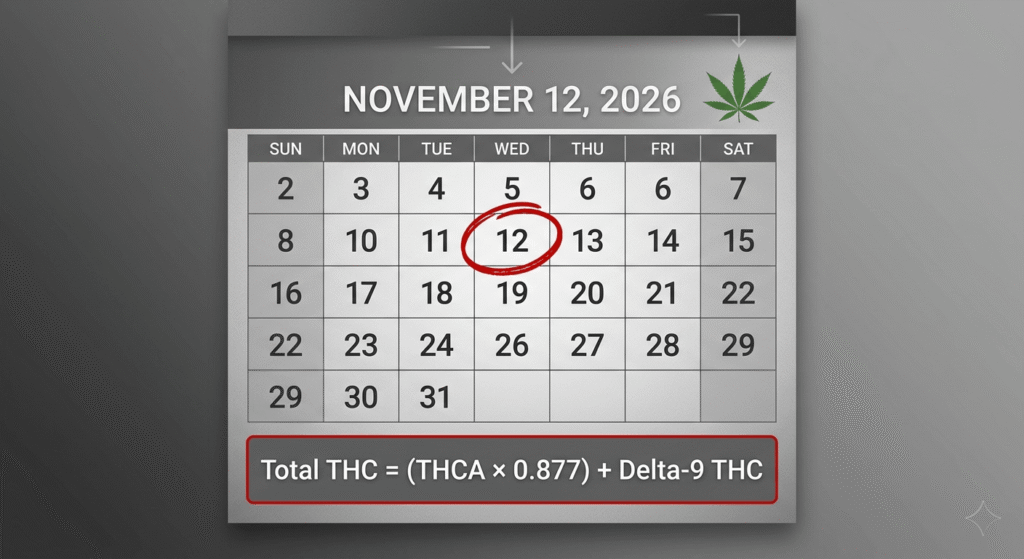
On November 12, 2025, President Trump signed H.R. 5371, embedding Section 781 into federal law. This provision rewrites the hemp definition using a total-THC formula: Total THC = (THCA × 0.877) + delta-9 THC. That change takes effect exactly one year later, on November 12, 2026. Until that date, the 2018 Farm Bill’s delta-9-only standard remains the operative benchmark.
The November 12, 2026 Deadline Explained
Three things change simultaneously on that date. First, hemp must test below 0.3% total THC by dry weight, pulling THCA into the legal calculation. Most THCA flower runs 20-35% THCA content, which fails the new threshold by a wide margin. Second, finished consumable hemp products face a hard cap of 0.4 mg total THC per container, eliminating the majority of gummies, edibles, and concentrates currently on shelves. Third, synthetic and converted cannabinoids including delta-8, HHC, and THC-O are expressly excluded from the hemp definition. The House-passed 2026 Farm Bill, approved 224-200 on April 30, 2026, would make these changes permanent agricultural policy.
Which States Have Banned THCA Outright in 2026?
Twelve states have moved ahead of federal law to prohibit THCA through their own statutes, often with criminal penalties attached. Idaho enforces a zero-THC policy, treating any THC or THCA content as a controlled substance. Kansas bans all THC isomers and derivatives statewide. Arkansas enacted Act 629 in 2023, prohibiting intoxicating hemp products including THCA flower outright.
Hawaii requires total-THC testing for hemp compliance and bans smokable hemp entirely. Tennessee’s ban took effect January 1, 2026, under House Bill 1376, ending THCA flower sales and online hemp delivery to the state. South Dakota’s restrictive hemp framework leaves no legal pathway for THCA outside its licensed cannabis program. Iowa bans smokable hemp and restricts most intoxicating hemp cannabinoids. Rounding out this group: Alaska, Delaware, Rhode Island (THCA classified as a controlled substance), New Hampshire (SB 505 banned all hemp products containing any THC, enacted August 2024), and North Dakota.
Texas sits in a separate category. The Texas DSHS total-THC rule effective March 31, 2026 would ban smokable hemp including THCA flower, but a Travis County TRO issued April 8, 2026 temporarily restrained enforcement. As of mid-2026, retail THCA flower in Texas operates in active legal uncertainty, not permissive territory.
Traveling into any banned state with THCA, even legally purchased product from elsewhere, creates genuine legal exposure. Federal preemption protects interstate transport under Section 10114 of the Farm Bill, but it does not protect consumers once products reach a prohibition state.
Which States Restrict THCA to Dispensaries Only?
Five states allow THCA but channel it exclusively through their licensed cannabis markets. Colorado, Montana, Nevada, Oregon, and Vermont all require intoxicating hemp-derived cannabinoids to move through state-regulated dispensaries. You won’t find THCA flower at a convenience store, smoke shop, or online delivery service in these states. Interstate online shipping faces serious compliance risk even into this group, since products must meet both federal and destination-state standards simultaneously.
Virginia operates a hybrid model worth understanding separately. The state adopted a total-THC standard in July 2023, capping products at 2 mg total THC per package except for items with a CBD-to-THC ratio of at least 25:1. The Fourth Circuit affirmed Virginia’s approach in January 2025, making it one of the most legally settled restrictive frameworks in the country.
State-by-State THCA Shipping Status
| State | THCA Status | Key Law or Rule | Ship Online? |
|---|---|---|---|
| Idaho | Banned | Zero-THC state policy | No |
| Kansas | Banned | All THC isomers prohibited | No |
| Arkansas | Banned | Act 629 (2023) | No |
| Hawaii | Banned | Total-THC + smokable ban | No |
| Tennessee | Banned (Jan 2026) | House Bill 1376 | No |
| Rhode Island | Banned | THCA = controlled substance | No |
| New Hampshire | Banned | SB 505 (Aug 2024) | No |
| South Dakota | Banned | Restrictive hemp framework | No |
| Texas | In flux | DSHS rule under active TRO | Check status |
| Virginia | Restricted | 2 mg total-THC/package cap | Limited |
| Colorado | Dispensary only | Licensed market required | No |
| Oregon | Dispensary only | Total-THC framework | No |
| Florida | Legal | Delta-9 Farm Bill standard | Yes |
| Georgia | Legal | Delta-9 Farm Bill standard | Yes |
| North Carolina | Legal | Delta-9 Farm Bill standard | Yes |
| South Carolina | Legal | Delta-9 Farm Bill standard | Yes |
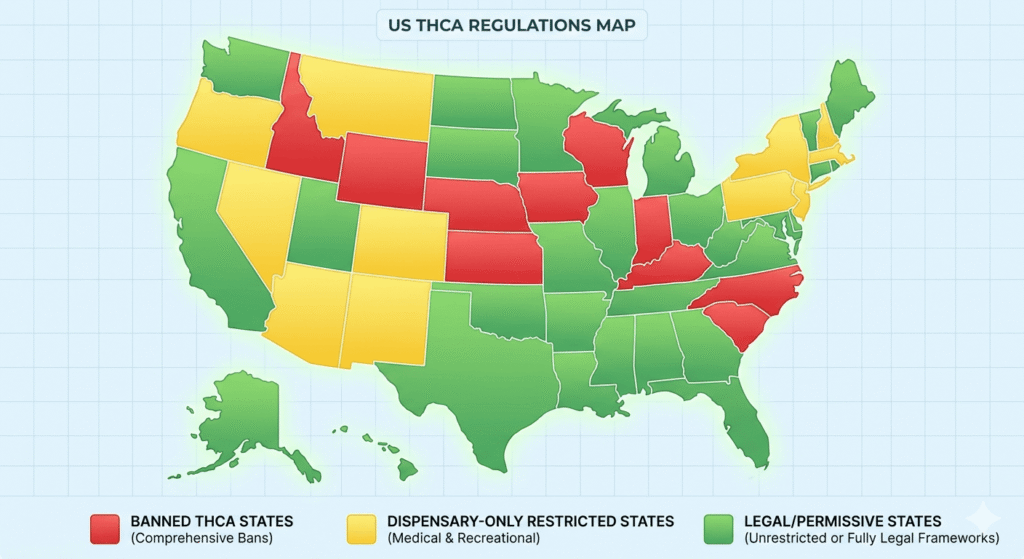
Most remaining states in this table follow the federal delta-9 standard and permit THCA purchases through hemp retail channels, including online ordering. Florida, Georgia, and North Carolina represent the largest permissive markets by population.
How to Check THCA Compliance Before Buying or Shipping
Doing this correctly matters. A missing step can result in seized packages, legal penalties, or wasted inventory.
- Confirm current state law at the destination. THCA laws 2026 moved faster than media coverage. Tennessee banned flower in January; Ohio’s SB 56 took effect March 20, 2026; the Texas situation remains unsettled. Always check current statutes, not summaries from six months ago.
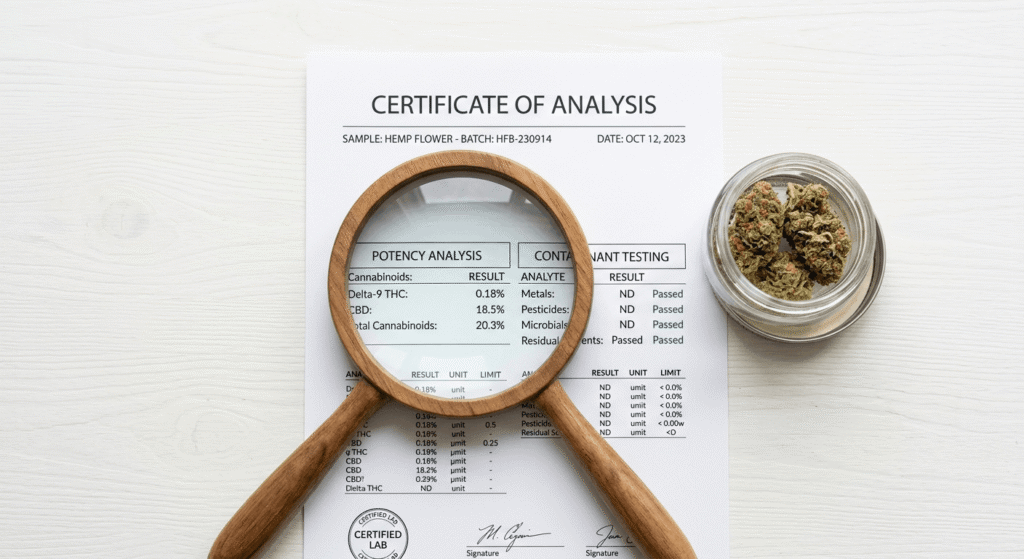
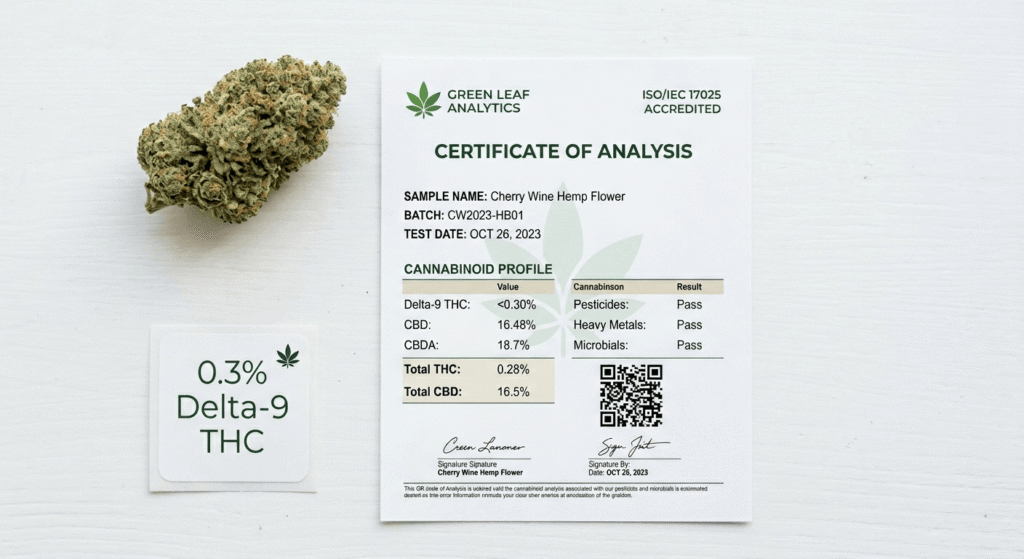
- Request a batch-specific Certificate of Analysis (COA). The COA must come from an ISO/IEC 17025-accredited laboratory and show delta-9 THC below 0.3% by dry weight. Batch-specific means tied to the exact lot you’re buying, not a generic product result.
- Apply the total-THC formula for restrictive states. States like Hawaii, Oregon, Minnesota, and Virginia use: Total THC = (THCA × 0.877) + delta-9 THC. Run that calculation against the COA before shipping to any of these markets.
- Verify carrier requirements. USPS permits hemp shipments with proper documentation and a compliant COA. UPS requires active enrollment in its Hemp-Derived Products Shipping Program, including a state hemp license. FedEx policies are inconsistently enforced and carry higher account risk.
- Save compliance documentation with every order. In states with active enforcement, having a COA on hand when a package is questioned is a real legal protection, not a formality.
- Recheck everything before November 12, 2026. Products compliant under the delta-9-only standard today may fall outside the new total-THC definition by year’s end.
Common Mistakes to Avoid With THCA Legality
The most common error is assuming federal legality covers all situations. Section 10114 of the 2018 Farm Bill protects the interstate transport of compliant hemp, but not retail possession or in-state use in a prohibition state. A purchase made legally in Florida creates problems if it crosses into Tennessee.
Relying on outdated COAs trips up both buyers and retailers. Lab results from six months ago don’t satisfy compliance reviews in states with active enforcement timelines. Some state regulations require testing documentation tied to specific batch dates.
Treating the Texas situation as fully resolved is another mistake. The TRO restraining the DSHS total-THC rule has extended enforcement, but the rule itself hasn’t been struck down. The litigation outcome will determine whether retail THCA flower survives in one of America’s biggest hemp markets.
Shipping via FedEx without prior account vetting is a consistent problem for wholesale operations. Even compliant shipments have faced seizure and account suspension. USPS or a UPS enrolled program is safer for documented bulk shipments.
What Should Retailers and Buyers Do Before the November Deadline?
The clock is running. Retailers in permissive states have a genuine window right now to serve customers while legal market access remains open. That window closes on November 12, 2026, unless Congress delays or replaces Section 781. H.R. 7024 (Hemp Planting Predictability Act) would push the deadline to November 12, 2028, and has bipartisan support, but has not advanced out of the House Agriculture Committee as of May 2026.
For wholesale buyers, this period favors building inventory and sourcing relationships while THCA flower legality still holds under the delta-9 standard. Understand what Farm Bill-compliant THCA looks like in practice before placing bulk orders. Our guide on Farm Bill compliant THCA for retailers walks through exactly what compliance documentation should include. Before stocking product, it also helps to understand how THCA and delta-9 THC differ in legal treatment and consumer experience. See our full THCA vs THC breakdown for that comparison.
Retailers vetting wholesale sources should also evaluate lab transparency and product consistency together. Finding the right wholesale THCA supplier is less about price per pound and more about COA documentation, strain quality, and whether a supplier operates in states where THCA regulations remain stable. For current wholesale pricing on compliant product, make sure any quote comes with the batch COA attached.
Frequently Asked Questions
1. Is THCA legal in all 50 states?
No. THCA is legal at the federal level under the current 2018 Farm Bill framework, but state laws vary sharply. At least 12 states have banned it outright and five others restrict sales to licensed dispensaries. Always verify your specific state before purchasing or ordering online.
2. What states have banned THCA in 2026?
Idaho, Kansas, Arkansas, Hawaii, Tennessee (as of January 2026), South Dakota, Iowa, Alaska, Delaware, Rhode Island, New Hampshire, and North Dakota have all banned or effectively prohibited THCA through state law or regulation. Texas currently restricts it through a rule that is under litigation.
3. Can THCA be shipped legally across state lines?
Yes, to states that permit hemp products, via USPS with a valid COA showing delta-9 THC below 0.3% by dry weight. You cannot legally ship to banned states. After November 12, 2026, the federal total-THC standard will eliminate most THCA products from legal interstate commerce entirely.
4. What happens to THCA legality after November 12, 2026?
The new federal standard counts THCA toward the 0.3% total-THC limit using the formula (THCA × 0.877) + delta-9 THC. Most THCA flower, which tests at 20-35% THCA, would far exceed that threshold and be reclassified as marijuana under the Controlled Substances Act. Interstate shipping would stop, and most current products would become federally illegal unless Congress delays or modifies Section 781.
5. Is THCA the same as THC?
No. THCA is the raw acidic precursor to delta-9 THC. In unheated form it’s non-intoxicating. When smoked or vaporized it converts to delta-9 THC through decarboxylation, producing the psychoactive effect users expect. That conversion process is exactly why regulators now want THCA counted toward total THC limits.
6. What does a valid THCA COA need to show?
A compliant Certificate of Analysis should display: the issuing lab’s ISO/IEC 17025 accreditation, the specific batch or lot number being tested, delta-9 THC content below 0.3% by dry weight, THCA percentage, and the test date. For states using total-THC testing, also apply the conversion formula before shipping.
7. Will the November 2026 federal deadline be pushed back?
It’s possible. H.R. 7024 (Hemp Planting Predictability Act) and the Cannabinoid Safety and Regulation Act (CSRA) both propose alternatives to the current Section 781 timeline. Neither has passed as of May 2026. Anyone making business decisions based on a delay is taking on real regulatory risk.
Conclusion
Is THCA legal? In most U.S. states, yes, but under a framework with a defined expiration date and sharp geographic limits. Twelve states have already banned it. Five more restrict it to dispensaries. The federal total-THC deadline of November 12, 2026 changes everything for buyers, retailers, and wholesalers still operating under the current delta-9 standard. Know your state’s laws, verify every COA, and treat the November deadline as the hardest constraint in the market right now. Legal THCA flower legality won’t look the same after this year.